
Key Results
Between August 2024 and May 2026 (two school years), The University of Nebraska-Lincoln:
- Achieved a 98% return rate
- Got 42% of students reusing
- Saved 218K single-use containers from landfill (top container has been used 174 times)
- Saved $76K in single-use packaging costs
- Saved 141K gallons of water
“Working with [Topanga] for ReusePass has been a true partnership. Their team is responsive, proactive, and committed to helping us overcome any challenges, and create a reusable container program that works for our unique campus operations.”
– Ellyn McCarter, Registered Dietician / Nutrition Manager, University Dining Services
Introduction
The University of Nebraska-Lincoln (UNL) is a large public self-operated institution serving nearly 24,000 students. UNL aims to become a zero-waste campus by 2030 through waste avoidance, reduction, recycling and reuse. One of its short-term objectives is to cut per-capita waste by 50%—a goal that hinges on students switching from single-use containers to reusables.
Problem
In 2019, the university launched a token-based reusable container program that ran on the honor system: students checked out a container and were trusted to return it. But good intentions only go so far, and participation never took off in the way it needed to.
The dining team had purchased 7,000 reusable containers, and by the end of the 2022/23 school year (including a COVID pause), only a few hundred remained in circulation—with nearly $50,000 in losses. It’s a challenge that honor-based reuse systems often run into: good intentions alone can’t drive campus-wide adoption. For the program to work, there needed to be better tracking and engagement.
Solution
A communications push was able to raise the return rate up to 50%, but UNL dining knew that still wasn’t enough to get the results they wanted. They turned to ReusePass, Topanga’s reusable container management system, to power a new-and-improved reuse program. The goal was to get much-needed infrastructure: robust inventory management, flexible container options, and the tech to drive real ROI without compromising the student experience.
One of the biggest differences from their analog system was ReusePass’ 1:1 student-to-container tracking. For the first time, they could clearly see how many containers were in circulation and who had them. With ReusePass, UNL would finally have data to measure the real impact of its reuse efforts.
“We chose ReusePass because they offered a practical and student-friendly solution to our challenge of reusable containers not being returned. The program fit naturally into our operations and was easy for guests and students to adopt.”
– Ellyn McCarter, Registered Dietician / Nutrition Manager, University Dining Services
Program Design and Setup
The program needed to mesh with campus life, which meant connecting ReusePass to students’ Transact mobile ordering flow.
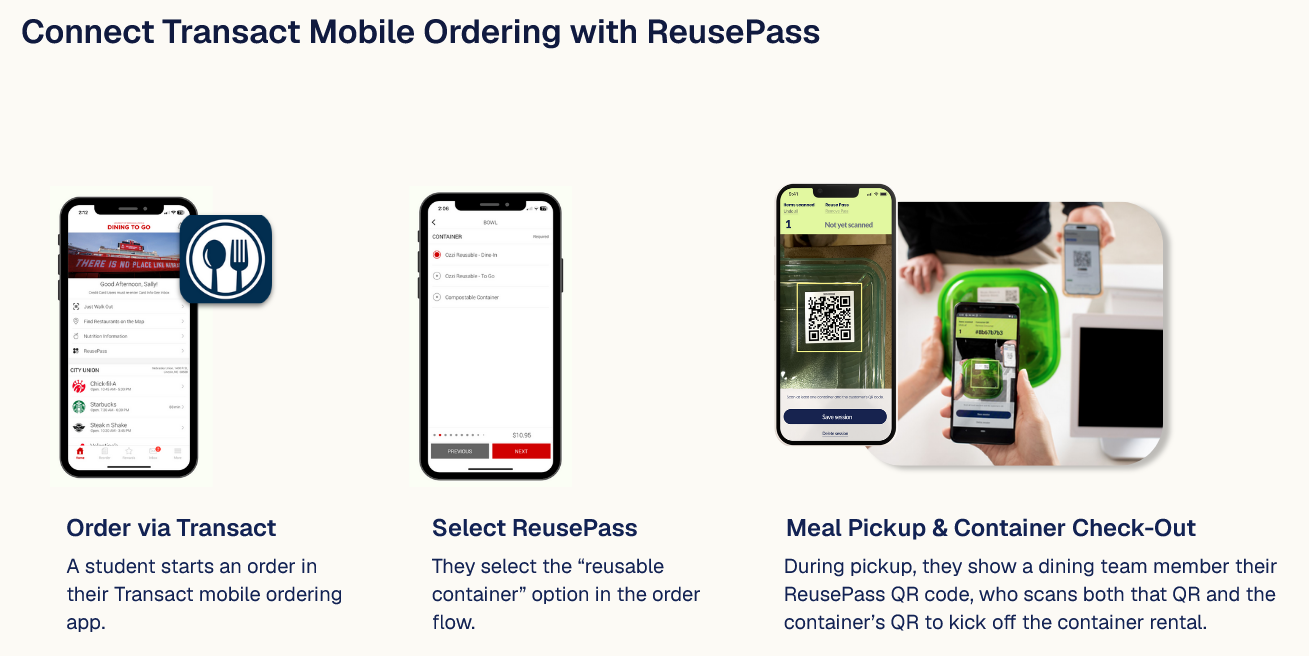
Here’s how it works:
- A student starts to place an order on their Transact mobile ordering app.
- They select the “reusable container” option while ordering and proceed to checkout.
- When picking up their meal, the student shows their ReusePass QR code to the cashier, who scans both the student’s QR code and the container’s QR code to check it out to the student.
The program was built to cover the full menu from the start, with five container types across entrees, bowls, sides and cups.
Program Launch
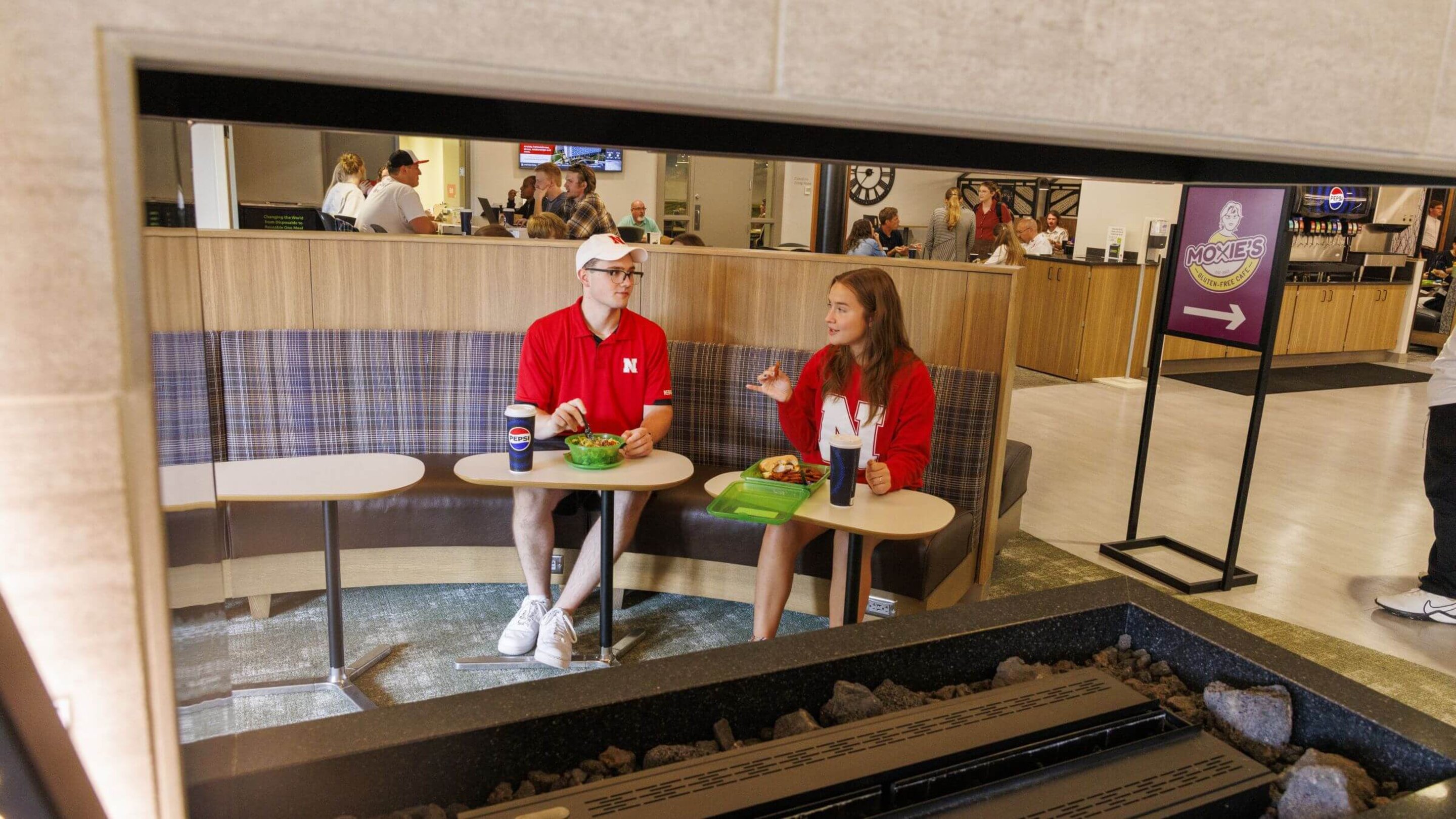
ReusePass launched in August 2024 across six retail cafes within the Selleck Food Court: Grains & Greens, QDOBA, Cold Creations, Pasta Buono, Scarlet Skillet and Selleck Cafe.
To maintain flexibility as students adjusted to the new offering, students were able to choose whether they wanted their meal in a reusable or single-use container. Also, the program launched without a late fee, which kept the experience low-pressure and removed any student financial concerns from the equation.
Program Expansion
Following a successful initial launch, UNL felt it was time to extend reuse across campus. The dining team worked closely with the sustainability team, running tabling events to get the word out about the expansion and help students sign up to ReusePass. After drumming up lots of interest, ReusePass launched through Transact mobile ordering at two new dining venues in fall 2025: Abel Dining, which includes five retail concepts, and East Campus’s AYCE dining hall. Return bins were expanded from 4 to 14, making it easier for students to return containers whenever they were on campus.
To encourage adoption, the dining team decided to introduce a $0.25 single-use surcharge. Together with a big marketing push, these changes drove an 8x increase in rental volume from the year before and reached 42% of the campus population.
How Topanga’s Engagement+ suite boosted participation
To take student engagement to the next level, UNL added our Engagement+ suite—custom, Topanga-built emails built around what actually influences behavior. ReusePass gives students the capacity to reuse, but the right communication at the right time is what turns a one-time user into a power user.
Acknowledgment emails, campus-wide promotions and localized messaging helped to build a culture of reuse. “Return received” emails gave students confidence that their returns had been logged, cutting return inquiries. Reminder emails targeted students with unreturned containers, giving them a friendly nudge to return them.
Campus-wide promotions got students’ attention. Last year’s Earth Day campaign, which offered free chips and salsa for six or more rentals, brought in 200 new signups, reactivated lapsed users and drove 735 additional returns in just one month.
Localized impact messaging focused on making the impact of reuse feel real—for example, telling students that the containers they’d saved, if stacked up, would reach 16 times the height of the Nebraska State Capitol. Tabling events, ReusePass-branded merch giveaways and AirPods Pro raffles kept the energy up and awareness high across campus.
Since [launching] ReusePass, we’ve seen a complete shift in students’ attitudes toward reusable containers. The marketing efforts and data-driven engagement strategies have increased campus awareness and created a strong reusable container program.
– Ellyn McCarter, Registered Dietician / Nutrition Manager, University Dining Services
Results
In just 21 months, the results speak volumes: students are all in on ReusePass. The UNL team set an initial goal of 100,000 reuses (over the academic year) in the fall ‘25 semester, which felt like a stretch at the time. After seeing how much of an impact ReusePass was having, that confidence quickly grew into a year-end target of 200,000, which they hit during Earth Month, ahead of schedule.
Their return rate is 98%, which is a 97% increase from the previous system’s best. The most used container has been used and returned 174 times, making that per-use cost just ~2 cents. One student has reused 442 times (“power user” doesn’t feel like a strong enough term here).
The environmental impacts have added up fast, too. 218K single-use containers have been diverted from landfill, 141K gallons of water have been conserved, and 146K lbs of GHG CO2e have been saved. Also, by switching to ReusePass, UNL saw an est. $76K reduction in single-use packaging costs.
UNL set out to build a reuse program that actually works, and that’s exactly what they’ve done. With the right infrastructure, tailored communications, and students who are willing to get on board, a once-struggling initiative has turned into actual savings and a culture that embraces reuse.

Interested in how Topanga could improve your dining program? Let’s chat.
We’ll walk you through how Topanga can support your goals and tailor a solution to fit your operation.


.png)
.png)