.svg)
How Comms Boosts Reuse: Lessons from Topanga’s Collaboration with Marketing Researchers at Penn State University
Last year, we collaborated with Penn State researchers who hypothesized that email communications acknowledging participation in Penn State’s (ReusePass-powered) PSreUse program would increase subsequent use. The results are even better than expected

Penn State's Reusables Program
In August 2023, Penn State Housing and Food Services launched a revamped version of their PSreUse reusables program, newly powered by Topanga’s ReusePass platform. They wanted to scale up reuse efforts across Penn State campuses and reduce the amount of single-use waste generated by dining halls.
The rollout was a team effort, and thorough preparation was key. In the run-up to the launch of the revamped program, dining staff collaborated closely with over 30 Residential Assistants to equip them with everything they needed to help diners navigate the change. Campus EcoReps also played a major role, serving as sustainability ambassadors to rally the student body around the program.
By December 2023, four months after the revamped reuse program was introduced at Penn State’s Behrend campus, the container return rate was 98% – 13% higher than the previous program. By the end of 2024, the student participant rate was 23.4%, and the percentage of PSreUse participants who had only reused one time was down 25%.
Testing a Theory: The Reuse Comms Experiments
Early results, and the expansion of PSreUse to other Penn State locations, prompted our team to start thinking about specific levers we could pull to drive desired student behavior across universities.
Around that same time, Amy Bressler, the Director of Residential Dining at Penn State, connected us with Sara Dommer, Assistant Professor of Marketing, and Karen Page Winterich, Susman Professor in Sustainability and Professor of Marketing, who, along with Yuly Hong, Assistant Professor at Neoma Business School, were interested in collaborating with us to test their hypothesis regarding acknowledgement of customer participation in reusables programs.
Together, we set out to test their theory around whether acknowledging reuse can spur further reuse, creating more engaged, repeat users.
Laying the foundations: Experiment #1
Working with Hong, Dommer, and Winterich, we decided to run a small experiment for a specific batch of users. After students at the University Park campus (Penn State’s largest) returned their PSreUse containers, we sent them an acknowledgement email, confirming their container had been returned and thanking them for doing so.
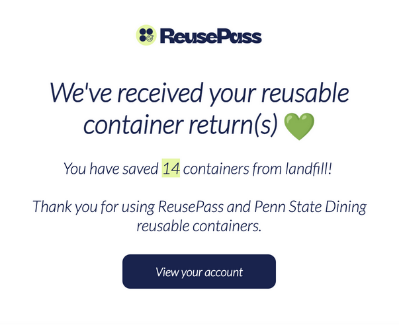
Experiment #1 delivered some promising results showing that students used the program more after receiving the acknowledgement email. However, the sample size wasn’t large enough for us to be sure of statistical significance.
Seeking statistical significance: Experiment #2
In 2025, we expanded the experiment to get a clearer view of how acknowledgement emails impact engagement. In experiment #2, we followed the same process as experiment #1: We sent PSreUse customers acknowledgement emails after they returned containers. However, instead of sending it to just a few users, we sent it to all Penn State diners who had opted to use the program.
The goal was to measure the impact of acknowledgement emails by comparing participation rates for the year before their introduction on January 27, the first day of the experiment, against participation rates during the experiment period (January 27-February 23).
The Findings: Acknowledgement Emails Increase Program Participation
Our hypothesis was supported. Acknowledging container returns in a direct email significantly improves participation. Here’s what we found:
Acknowledgement triples participation
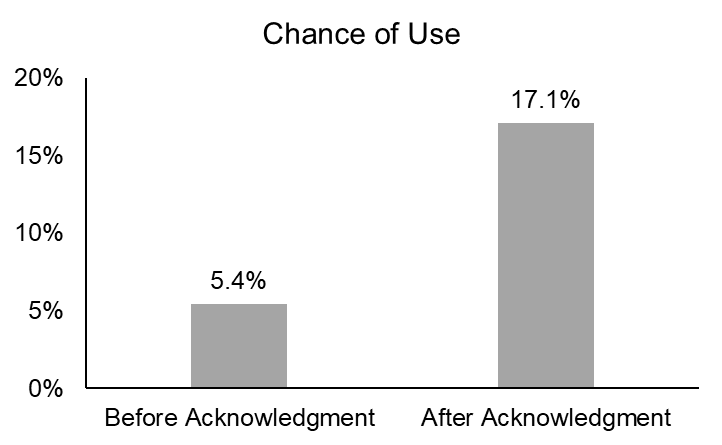
Without an acknowledgement email, there was a 5.4% chance students would reuse again. Once students began receiving “return received” emails, this figure jumped to 17.1% – more than tripling participation.
We also had at least one ‘power user,’ who completed 18 container rentals in just one month.
Even after accounting for other factors, such as user activity before acknowledgement, the number of acknowledgement emails received, holidays, and days of the week, repeat usage likelihood still jumped from 5.1% to 7.5% after an acknowledgement email. This means that after receiving an email, on any given day a student was 47% more likely to reuse than if they hadn’t received the acknowledgement.
Acknowledgment especially increases use for less active users
We also wanted to understand whether acknowledgement worked better for less active or more active PSreUse customers. We found that acknowledgement emails had an even greater impact for students who hadn’t participated much before. For less active users, the reuse likelihood increased by 62% after receiving the emails.
Additional emails increase participation
We also saw that the emails created a cycle of validation: the more return acknowledgement emails a diner received, the more likely they were to continue using the program. It just goes to show that a little communication goes a long way toward keeping diners motivated to reuse.
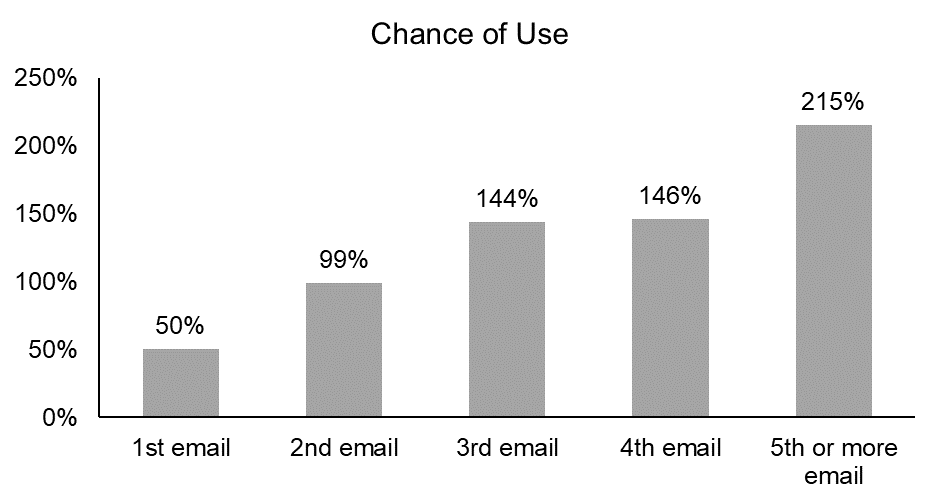
These results show: acknowledging participation works. The act of sending a simple email confirming container receipt appears to keep diners engaged with the program and increases the likelihood they’ll reuse again. That translates to a higher ROI and less waste.
And That’s Just the Beginning
Marketing professors, Yuly Hong, Sara Dommer, and Karen Winterich, just released a research paper exploring what makes students more likely to reuse. You can read their findings here.
Inspired by the professors’ findings, we wanted to bring these results to other ReusePass campuses. We ran different email tests at several other sites, which led to the launch of our new communication suite: messages to diners that are proven to drive transactions, boost meal plan engagement, and foster positive sentiment—all while keeping more containers in rotation.
This entire initiative shows that impactful partnerships can take unexpected forms, and that each university department can contribute to campus-wide sustainability programming. We’re grateful for the innovation happening on our own clients’ campuses, and are excited to keep building strong reuse systems across the country.
If you’re looking for a solution that makes cutting waste feel easy, we’d love to chat with you about ReusePass.
Continue reading

A Chef's POV: Managing With the Same Precision You Cook With
Chef Chris Aquilino draws on 35 years in kitchens to unpack how culinary leadership has changed. For the chefs who thrive today, systems are just as important as skills: getting data, improving demand forecasting, and sharing the knowledge across the team.

Why Tracking Waste is Just the Start, Not the Solution
Trustworthy production data is a kitchen's foundation. But it’s what happens next—how (or if) that data is used—that really makes the difference. Most tools in-market don’t make that easy enough for foodservice operators.