.svg)
How Can Hospital Kitchens Prevent Costly Overproduction?
Hospital foodservice teams, tasked with running both tray service and cafeteria production, need easy-to-use technology that will alleviate their outsized workloads. Learn how we help healthcare kitchens prevent costly overproduction while saving chefs' time.

Hospital foodservice teams have to navigate a complex web of challenges—beyond the standard staffing, forecasting, and inventory management pain points all culinary teams face—to feed their patients, visitors, and hospital staff.
Because of these nuances, technology and systems purpose-built for ex) higher education foodservice don’t necessarily translate to hospital dining environments.
Topanga began as a technology company building waste prevention systems for colleges and universities, but we’ve since broadened our scope to support a wider range of foodservice kitchens. We recently launched StreamLine, our production optimization platform, in several hospital kitchens, so are outlining exactly where we can and can’t help healthcare foodservice teams operate more efficiently.
What is StreamLine?
StreamLine functions like a decision engine for your hospital kitchen; culinary teams get trusted service results and clear planning guidance to prevent overproduction and wasted labor hours.
StreamLine replaces error-laden service worksheets and clunky, waste-only tracking systems with automated data collection, accurate service results, and more nuanced insights.
Also, you won’t need to wait months to see results. Complex rollouts or intensive training requirements thwart real impact and adoption, which is why StreamLine is designed to get you from signature to data capture in just 2 weeks.
Fast Implementation: Our team handles the heavy lifting, working with you to map your station footprint and identify immediate opportunities to alleviate staff workload.
Bite-Sized Progress: You can start by capturing data to understand your overproduction costs, then work with our team to roll out deeper operational support and process changes as time goes on.
How StreamLine Works
StreamLine makes it painless for chefs, general managers, and production managers to get much-needed visibility. Here’s what happens, on the line and under the hood:
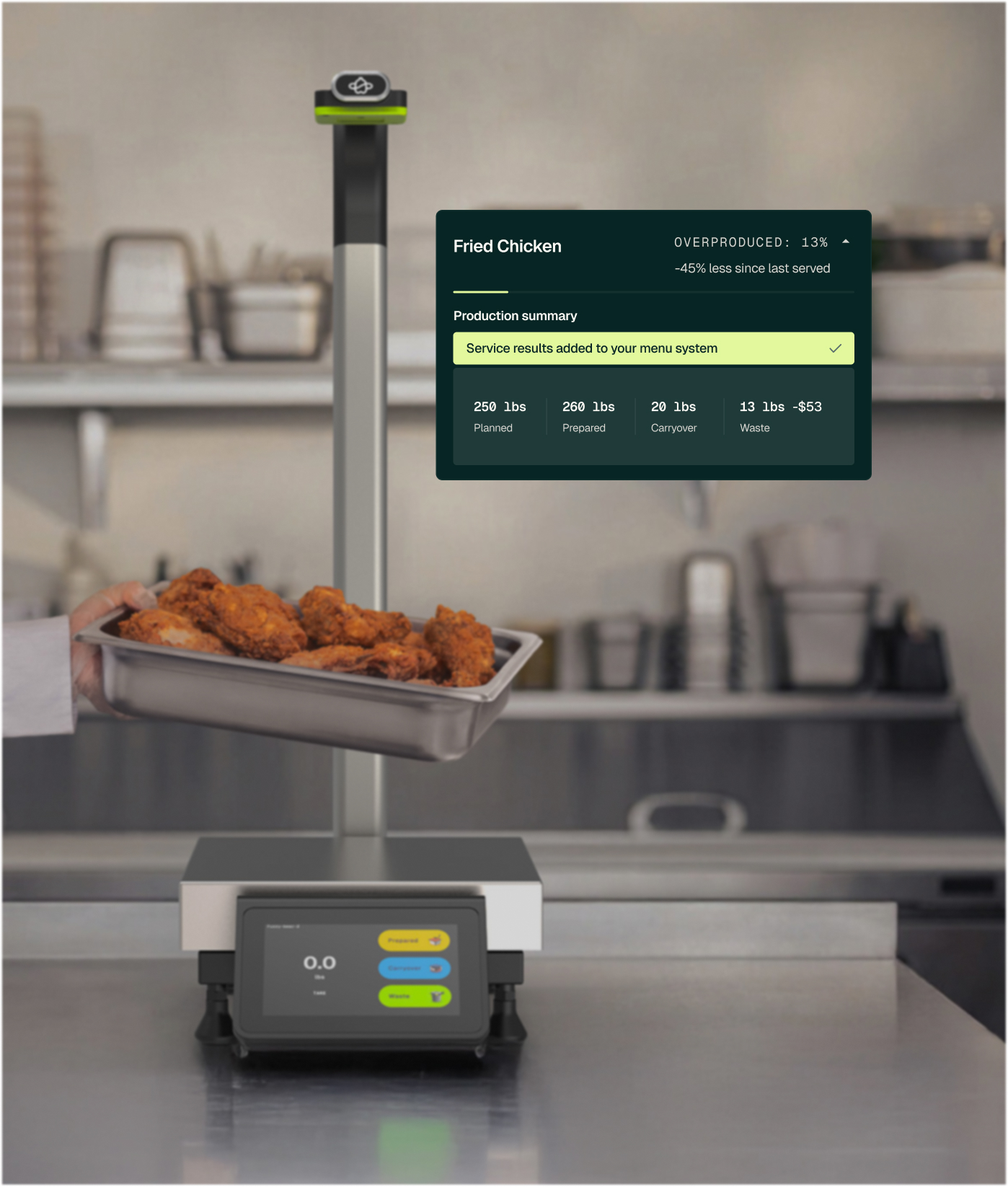
- Capture Staff user countertop smart scales to record trays of prepared, carryover, or wasted food with just one touchscreen tap.
- Analyze AI identifies and tags the right menu item, pulls in cost information from your menu system, and recommends interventions for your biggest budget drains.
- Act Chefs and general managers review results and planning suggestions in their StreamLine dashboard and weekly waste-reduction email reports. Service data is also auto-added back into Jamix and Prima, with more bi-directional integrations menu management system integrations coming soon.
Instead of only recording what's discarded, StreamLine gives teams the ability to see and solve inefficiencies across the entire production cycle. Foodservice kitchens using StreamLine regularly achieve a 50% reduction in their total volume of food waste, and can save 330+ hours per chef, per year with this fast, integrated approach to tracking production.
The State of Employee and Visitor Dining
Hospital staff and visitors purchase food from the cafeteria (and/or a retail cafe, where applicable). Order and production volumes are often determined using a standard employee purchase rate and a guest estimate that’s based on the number of beds filled. All food that isn’t pre-packaged is prepared in the hospital’s central production kitchen.
Needs & Challenges
For the most part, culinary teams don’t have accurate historical data about whether (or by how much) a given menu item was overproduced. Worksheets are full of guesstimates and nonsense numbers, which perpetuates the cycle of imprecise demand estimates → over or under production → wasted food, unnecessary prep, squandered funds, or frantic shifts.
We’ve calculated that a large hospital loses ~20% of their food budget on waste each year (EPA). This is already an unsustainable amount, but it’s quickly becoming an even greater problem as rising food and labor costs squeeze razor-thin margins.
StreamLine’s Role
StreamLine gives culinary leaders the ability to quickly see and solve top waste sources—especially those, like proteins, that pose the biggest bottom-line threat. Teams can track prepared, carryover, and wasted food on the same StreamLine smart scale, though some kitchens will have dedicated waste scales to alleviate any food safety concerns.
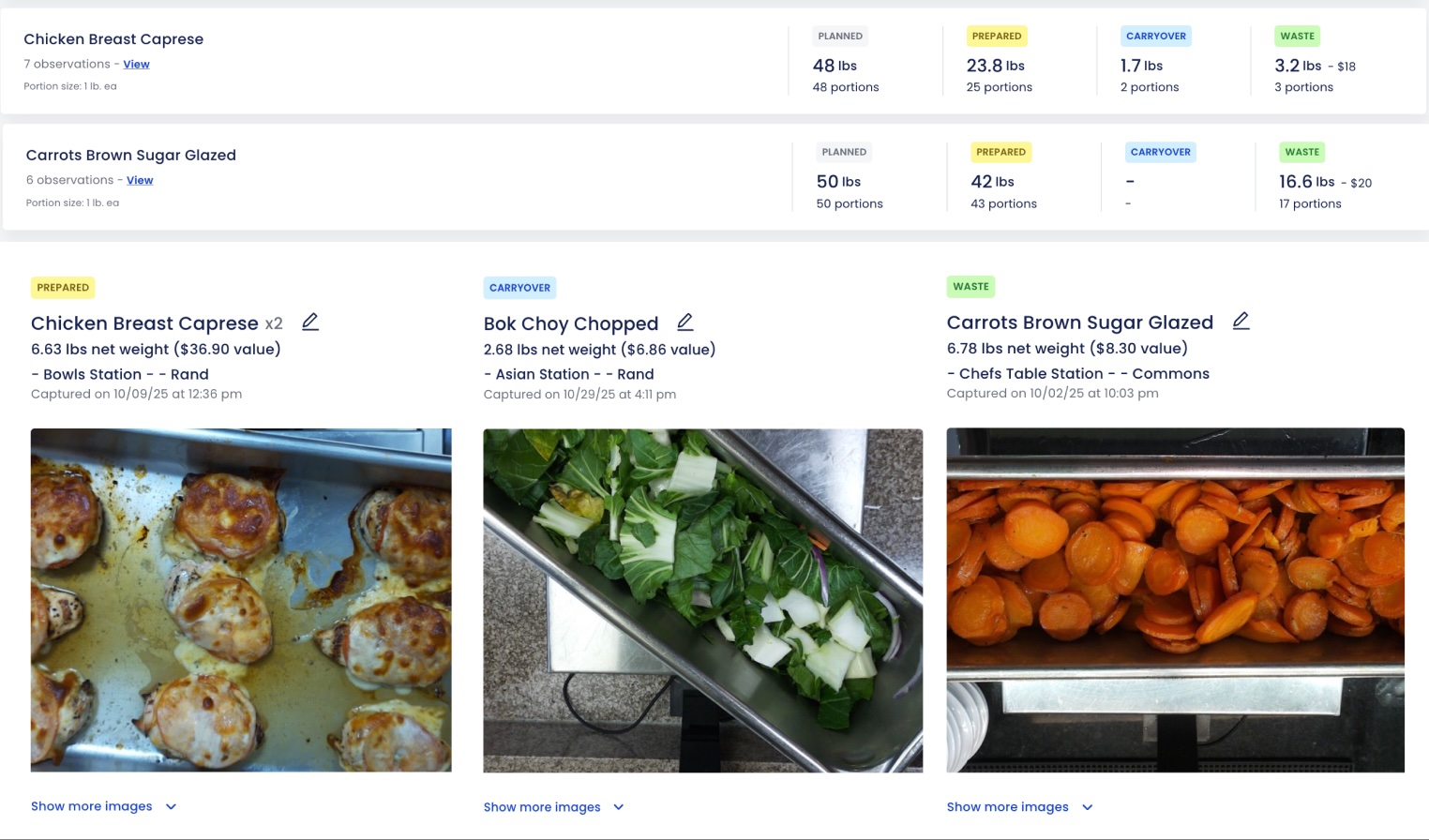
Scale data is matched to your exact menu items, summarized, and analyzed for hidden trends and opportunities.
With this complete picture of production, chefs and general managers are able to pinpoint why waste is occurring, train staff based on observed issues (like not prepping to plan or consistently over-firing eggs), and adjust future production plans accordingly.
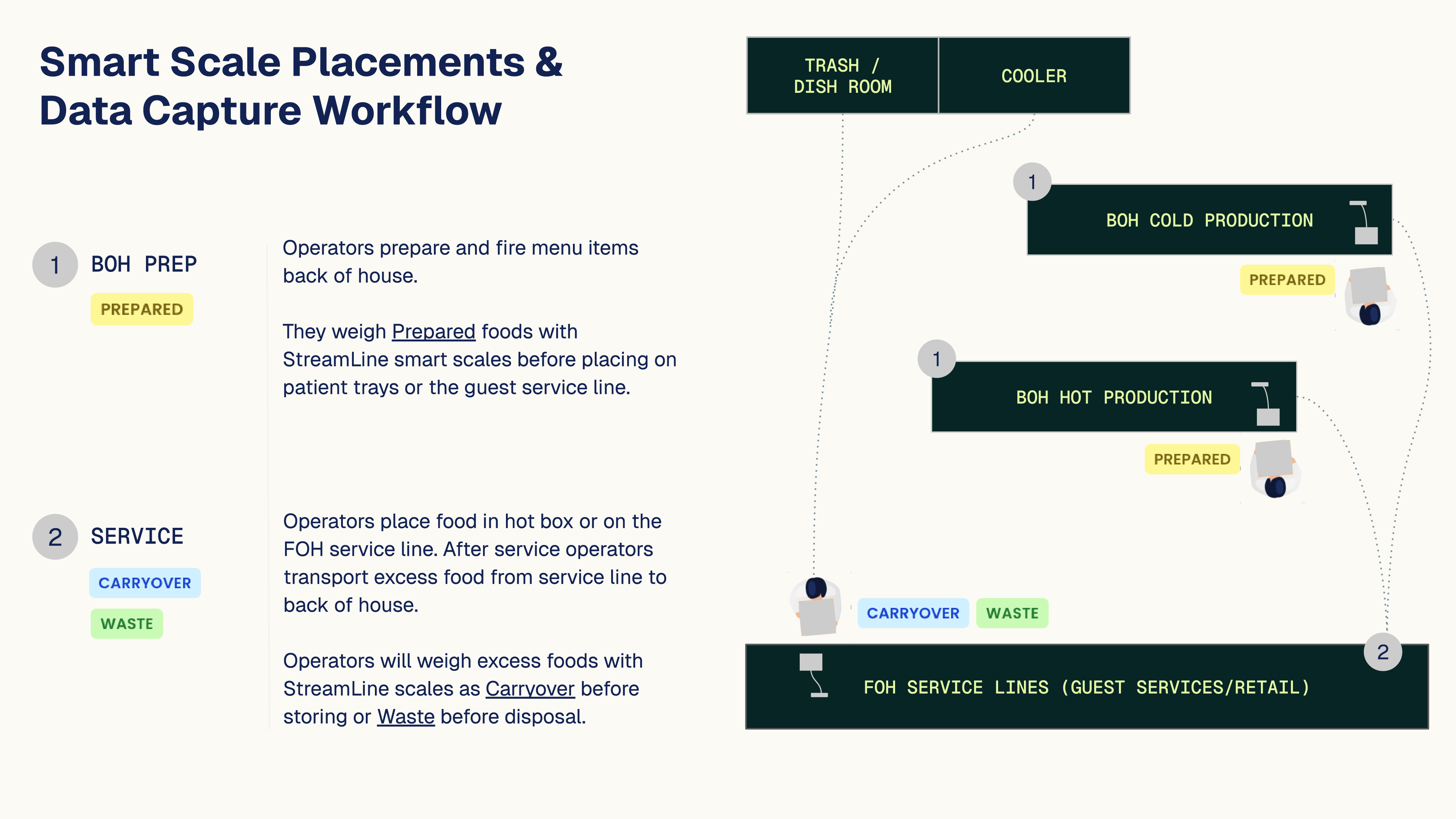
In the central production kitchen, scale placement is critical for achieving the desired day-to-day adoption. We typically recommend that scales for recording prepared, carryover, and food waste (likely trimmings) are placed at both hot and cold production stations, then a scale configured to only record waste and carryover is placed near the front-of-house service line. Each kitchen is unique, though, and our expert implementation team will develop a custom scale placement strategy based on your existing workflows and station footprint.
The State of Patient Tray Service
In the central production kitchen, patient meals are assembled on a patient tray line and tailored to each patient’s care plan and restrictions.
Needs and Challenges
Adhering to and keeping track of patient dietary restrictions and needs is business critical, yet disconnected dining systems send staff scrambling for answers (wasting hours each day) while preparing meals.
On the other hand, because diet orders are based on a limited menu, trays are assembled for patients, and many items are pre-packaged and shelf-stable (like applesauce), it’s much easier to predict production volumes and limit pre-consumer waste.
Understanding post-consumer (plate) waste continues to be of interest for healthcare teams, through for different reasons than in the C&U space—hospitals want a tray tracking solution that would allow them to record a patient’s uneaten food and understand the implications for their care plan.
StreamLine’s Role
StreamLine is purpose-built for cafeteria-style production tracking, where overproduction is most common and costly—not for recording spoiled, pre-packaged items that are counted as an “each,” like a carton of milk.
We do support teams who want to understand their total volume of post-consumer plate waste and identify which dishes aren’t meeting quality standards, but don’t currently offer an off-the-shelf tray tracking solution to monitor what a given diner left behind. We’re happy to share more about our ever-evolving approach to post-consumer plate waste on a call!
Implementing StreamLine: What to Expect
Whether you want immediate production visibility or prefer to ramp up slowly to build staff comfort, we’ll work at your preferred pace. Our team will meet you right where you are to design a system that works for your unique kitchen.
At the highest level, the typical timeline from contract signature to your first shift with StreamLine is 2 weeks. Here’s what the full planning and launch process entails:
Phase 1: Discovery (Pre-Signature & First Week of Implementation)
Our team meets with yours to determine your specific goals. Do you want to track everything out of the gate (prepared + carryover + waste), or start smaller with just waste tracking? We will help you right-size the rollout so it fits your current workflow.
Phase 2: The Rollout
Once the plan is set, we configure and ship your smart scales, share on-demand training signage and materials, and start chatting menu data. We conduct live training sessions so your staff feels comfortable and confident with the equipment on Day 1.
Phase 3: Ongoing Implementation & Support
You will meet with a dedicated Client Success Manager regularly to review your progress. We help you interpret your service data to find short-term wins (like cutting food costs) and map out long-term opportunities—such as optimizing labor, expanding to new locations, or adding new layers of tracking, if and when your team is ready.
Next Steps
If you want smoother shifts, better data, and more cost-effective menu cycles, request a StreamLine demo here. Regardless of whether your hospital has 100 beds or 1,000+, our team will be able show you exactly how StreamLine could support your culinary program.
Continue reading

A Chef's POV: Managing With the Same Precision You Cook With
Chef Chris Aquilino draws on 35 years in kitchens to unpack how culinary leadership has changed. For the chefs who thrive today, systems are just as important as skills: getting data, improving demand forecasting, and sharing the knowledge across the team.

Why Tracking Waste is Just the Start, Not the Solution
Trustworthy production data is a kitchen's foundation. But it’s what happens next—how (or if) that data is used—that really makes the difference. Most tools in-market don’t make that easy enough for foodservice operators.