.svg)
.jpg)
What a New Report Reveals About the U.S. Food Waste Crisis
Some of the U.S.’s biggest retail and foodservice businesses have committed to reducing their food waste. Here’s what ReFED’s data says about the progress they’re making.

According to ReFED, 29% of food produced in the U.S. goes unsold or uneaten each year. Food waste has a wide-ranging set of impacts for planet, people and profit. The total greenhouse gas emissions from food waste are the equivalent of driving 51 million cars for an entire year. 115 billion meals are going to waste each year, enough to feed a third of the U.S. population for a year.
Particularly stark is the fact that, in 2023, one in seven Americans experienced food insecurity. For food businesses, including farms, manufacturing, foodservice and retail, the total value of all the unsold and uneaten food is $243 billion—1.3% of U.S. GDP.
These statistics are hard to digest, but they demonstrate just how important it is that we collectively reduce food waste. The U.S. Food Waste Pact is one organization working to take a bite out of the national food waste crisis. The national voluntary agreement is led by ReFED and the World Wildlife Fund (WWF) and helps food businesses accelerate progress toward their waste reduction targets. We recently attended ReFED’s Progress in Reducing Food Waste webinar to dive into the much-anticipated U.S. Food Waste Pact 2025 Impact Report.
Here’s what the panelists from ReFED and the WWF had to say about how businesses across the food supply chain are working to tackle the food waste problem.
Food waste is a systemic problem
Food waste is such a difficult problem to solve because it’s systemic—the entire supply chain needs to work together to address it. “There are policies, behaviors and decisions across this entire supply chain that can drive waste up and downstream,” said Jackie Suggitt, Vice President of Business Initiatives and Community Engagement at ReFED.
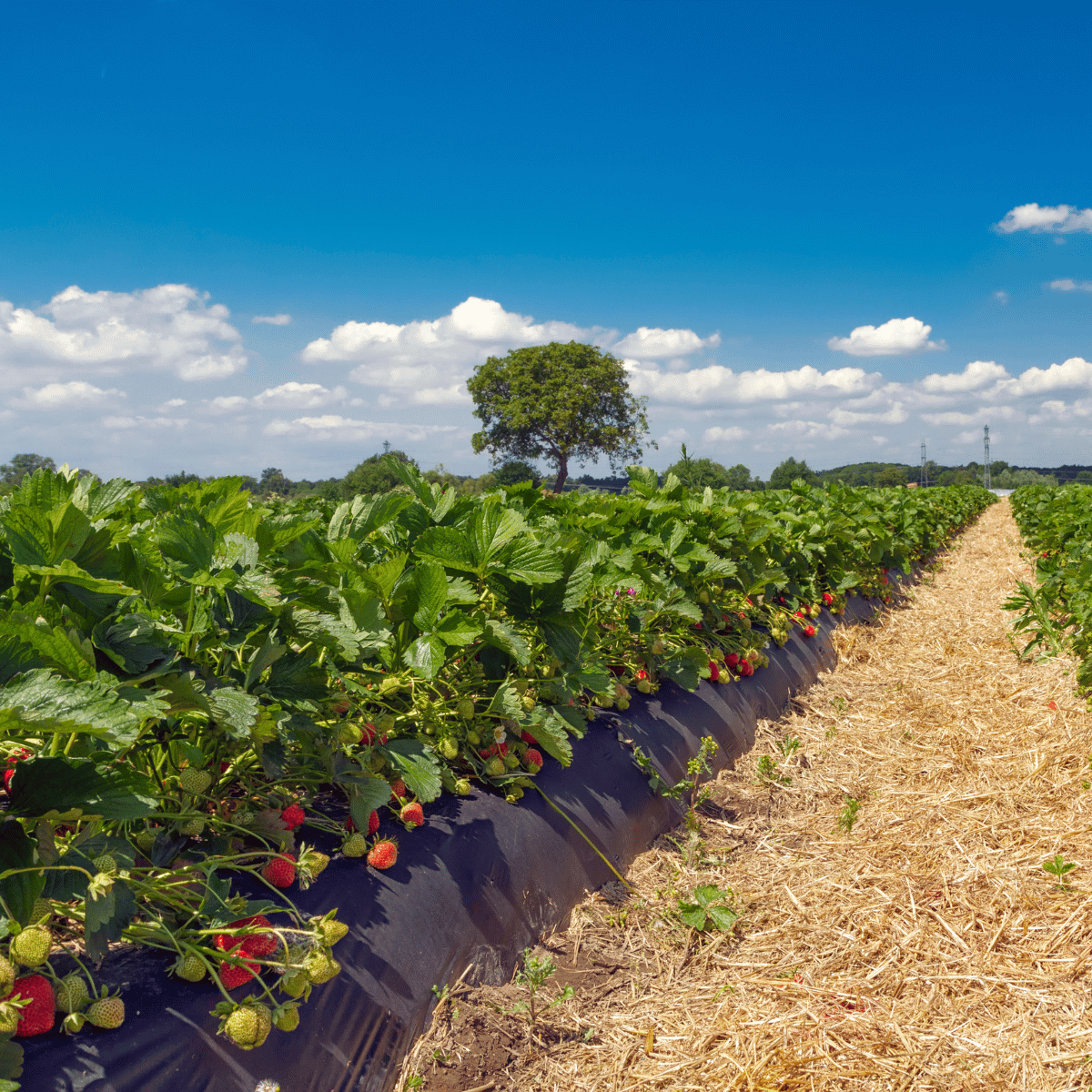
Jackie gave the example of strawberries, explaining that customers require quality and aesthetic specifications to be met before they can be sold. “A completely edible strawberry may never make it off the farm because it's discolored, misshapen, or too small,” she said. It’s a problem no single business can solve alone, which is why the Pact’s cross-industry approach matters.
What impact is the Pact having on food waste reduction?
Kristen Lee, Director of Business Initiatives at ReFED, explored the positive impact the Pact is having on reducing food waste. She explained that the number of signatories nearly doubled in 2025, from 16 to 30, including big names across the food supply chain such as Aldi, Walmart, Aramark, Sodexo, Starbucks and Hilton.
“This broader base really allows us to better permeate the food system, which is critical for making an impact on the systemic issues,” she said. 2025 also saw the Pact welcome its first grower, producer and distributor signatories, meaning the supply chain is now more fully represented.
A core pillar of the Pact is data collection. Retail and foodservice signatories report food waste data to ReFED each year, allowing ReFED to observe national trends. Using this anonymized data, Kristen examined the progress in reducing food waste across two sectors: retail and foodservice.
Retail
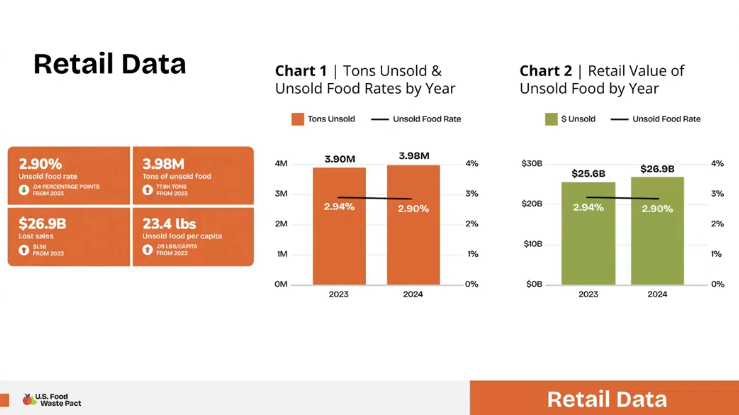
In retail, the unsold food rate decreased from 2023 to 2024, although total tons wasted and lost sales increased. “This means that while market fluctuations and business performance across the sector resulted in more food passing through grocery stores, food waste is still decreasing based on the share of retail inventory that goes unsold,” Kristen said.
ReFED also collects destination data to see the pathways food waste is taking, and to their delight, there was a notable increase in donations. Retailers reported an 18.25% donation rate, 4 percentage points higher than the previous year. “This is the most desirable pathway for surplus food to take, according to the EPA’s wasted food scale,” Kristen said.
The scale of the data behind these findings is worth drawing attention to: ReFED’s retail signatories represent over 50% of U.S. grocery market share, making this one of the most comprehensive pictures of retail food waste available nationally.
Foodservice
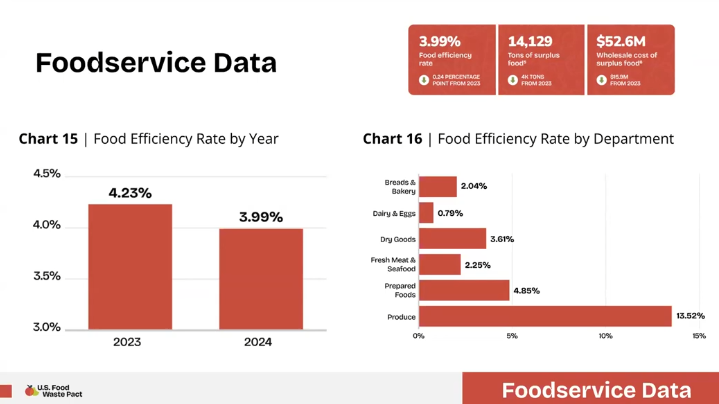
ReFED’s foodservice signatories reported a decrease in food efficiency rate between 2023 and 2024, meaning less food was being wasted. On top of that, the total tonnage and wholesale cost of surplus food also reduced. “That could point to greater operational efficiency… as well as improved data quality, which we always love to see,” Kristen said.
To solve the food waste problem, organizations need to understand its root causes. Kristen explained that it was the first year ReFED received this data from signatories, which allowed them to dig into the reasons food waste was occurring.
“We saw that trimmings and byproducts were the leading cause of wasted food in foodservice overall, and that accounted for almost 70% of waste in the produce department,” Kristen said. There were also positive signs that waste is being directed to more desirable places, with less food going to landfills and more going to composting and donations.
The power of pilot programs
Knowing where food waste happens is only half the battle—the next step is finding and implementing real-world solutions. Tara Dalton, Circular Supply Chain Manager for Food Loss and Waste at the WWF, walked attendees through the results of the Pact’s 2025 pilot projects.
The strawberry pilot
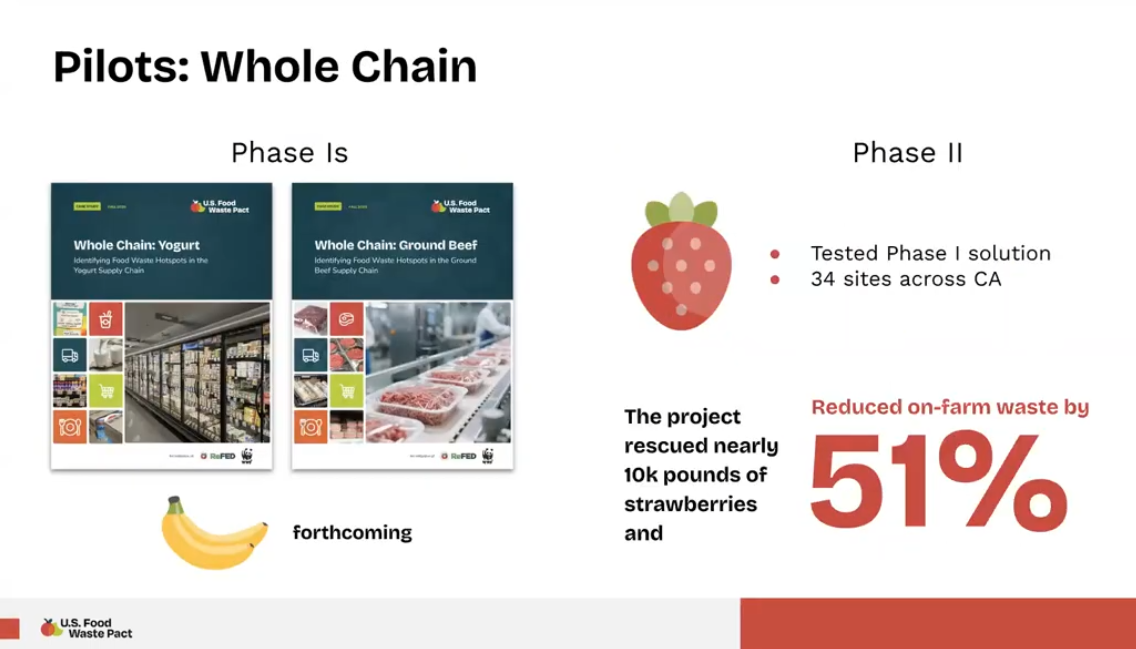
Earlier in the webinar, Jackie gave the example of the completely edible but cosmetically imperfect strawberries going to waste on farms across the country. In 2025, the Pact ran a whole chain pilot to test a solution to this issue.
While aesthetic specifications matter to grocery shoppers, they're less of an issue in foodservice settings, where fruit is processed and used in new recipes. “This pilot involved a lot of different companies and supply chain partners, and had really exciting results, including increasing grower revenue by 80% and reducing on-farm strawberry waste by 51%,” Tara said.
Tackling food waste at events
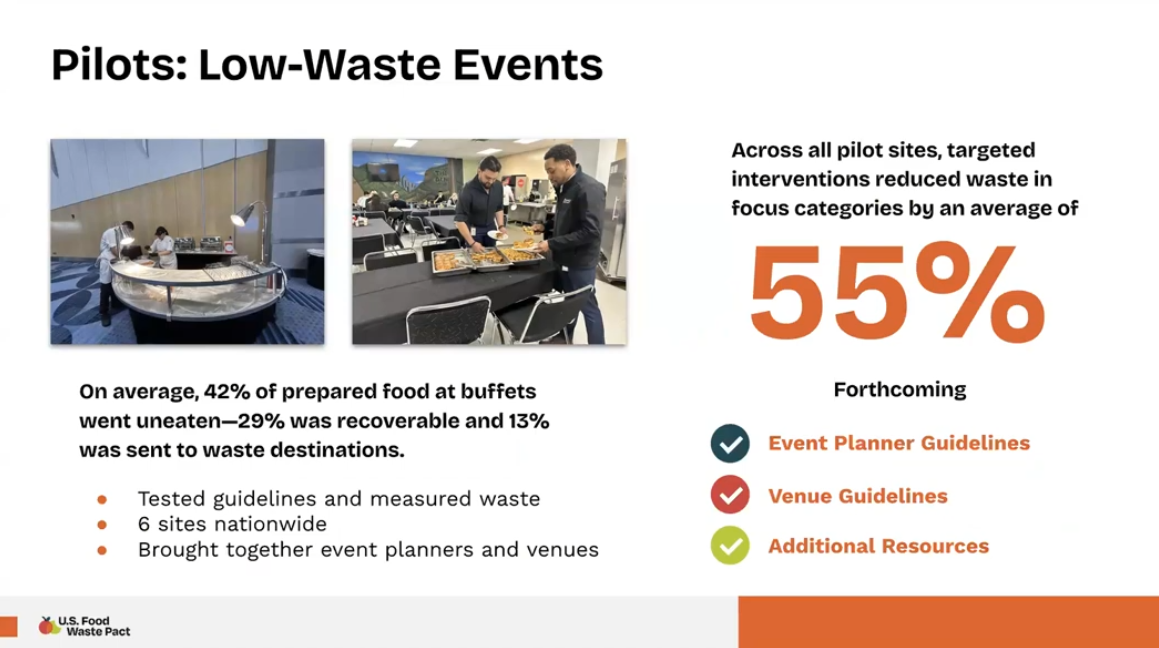
Another focus of the Pact was reducing waste at events, and some of the statistics that came out of the pilot were striking. They found that 42% of food prepared for buffets went uneaten, and that figure didn’t even include kitchen prep waste or plate waste.
What was causing food waste at this scale? “A common fear in hospitality is running out of food. You never want to run out of food and disappoint the client,” Tara said. She also pointed out that a lack of measurement infrastructure is a major hurdle for the industry. To address these challenges, an ad hoc working group of experts helped develop guidelines for event planners and venues hosting meeting-style events and conferences.
The guidelines targeted food categories that were commonly wasted, including breads, dressings, sauces and fruit. Implementing these guidelines reduced waste in those categories by 55%. Tara also pointed out that these venues still had leftovers at the end of the day. “This pilot really showed that we have a lot of progress that can be made, and waste can be reduced before we even get close to running out of food.”
Engaging frontline employees in food waste reduction
Tara also discussed the Pact’s four employee engagement pilots, which found that empowering kitchen staff and frontline workers to share their ideas for reducing waste made a measurable difference. “Across the four employee engagement pilots we’ve run to date, frontline workers have generated ideas that resulted in an average reduction of 66% in targeted commodities,” Tara said.
That 66% average reduction, driven by ideas from the people doing the work, shows just how much untapped potential exists on the frontline. To help companies operationalize the findings, the Pact produced step-by-step guides on how to engage workers in food waste reduction efforts in kitchens.
Overcoming the “we don’t waste food” fallacy
Despite clear progress in retail and foodservice food waste reduction, the belief that a business isn’t producing any food waste still remains. “I feel like that’s the biggest flag when an operator says, ‘Oh, no, we don’t have waste.’ So we always know that when folks don’t think they have waste, there’s an opportunity for that waste to be tracked,” Kristen said. “The common phrase goes: you can’t manage what you don’t measure.”
The Pact is actively encouraging restaurants and foodservice operators to track their waste. “We know that in restaurants and foodservice, they’re wasting about 4% of all the food they buy. That’s not a small percentage, and it translates to real dollars,” said Kristen.
She pointed out that, of that 4% wasted food, just over a fifth comes from overproduction. The remaining consists of un-utilized ingredients, with trimmings and byproducts being the biggest contributors. Getting operators past their initial denial and setting up proper tracking systems is the first step to identifying these hidden losses.
What’s next for the U.S. Food Waste Pact
The webinar concluded on an optimistic note, with panelists discussing their ambitions for 2026. Having demonstrated what’s possible through successful whole-chain collaboration pilots, low-waste events and employee engagement strategies, the focus inevitably shifts to scaling.
Tara described Q1 2026 as a period of “brewing and stewing”—a time to think carefully about how to help the Pact’s signatories, other businesses and groups outside the private sector adopt and embed these food waste reduction solutions more broadly. “We’re establishing new strategies, like launching task forces and industry groups… and different kinds of formats of pilots that we aim to test this year,” Tara said.

Kristen echoed Tara’s optimism. “I just see there being so many areas of opportunity, especially in how we help signatories and other businesses operationalize on the learnings from the case studies and pilots.” With more data, more partners and proven solutions at the ready, the U.S. Food Waste Pact looks well-placed to turn promising pilots into industry-wide change.
We came away from the session feeling encouraged by the data the panelists shared. The scale of the food waste problem can feel overwhelming, but the Pact’s 2025 results are a reminder that targeted, collaborative action can deliver measurable change. If you missed it, you can watch the webinar here.
Continue reading


A Chef's POV: Managing With the Same Precision You Cook With
Chef Chris Aquilino draws on 35 years in kitchens to unpack how culinary leadership has changed. For the chefs who thrive today, systems are just as important as skills: getting data, improving demand forecasting, and sharing the knowledge across the team.

Why Tracking Waste is Just the Start, Not the Solution
Trustworthy production data is a kitchen's foundation. But it’s what happens next—how (or if) that data is used—that really makes the difference. Most tools in-market don’t make that easy enough for foodservice operators.