
.svg)
Why Tracking Waste is Just the Start, Not the Solution
Trustworthy production data is a kitchen's foundation. But it’s what happens next—how (or if) that data is used—that really makes the difference. Most tools in-market don’t make that easy enough for foodservice operators.

Foodservice teams have gotten serious about reducing food waste; a 2022 survey survey of U.S. college and university dining programs found that 75% had set a specific waste-reduction goal, and 77% were already tracking what was tossed. This push is for good reason: based on EPA data, we estimate that the average foodservice kitchen loses 7-15% of their annual food budget on waste.
But seeing waste isn’t the same as preventing it.
Tracking lays the foundation
The goal of most tracking systems in-market today is to show you what, and how much, was wasted. Getting trustworthy data is the right first step, and the rise of computer vision-enabled hardware has made this seem easy: take pictures, categorize, summarize. The issue is that photos or summary data alone aren’t enough for chefs, production managers, and purchasing teams to act on.
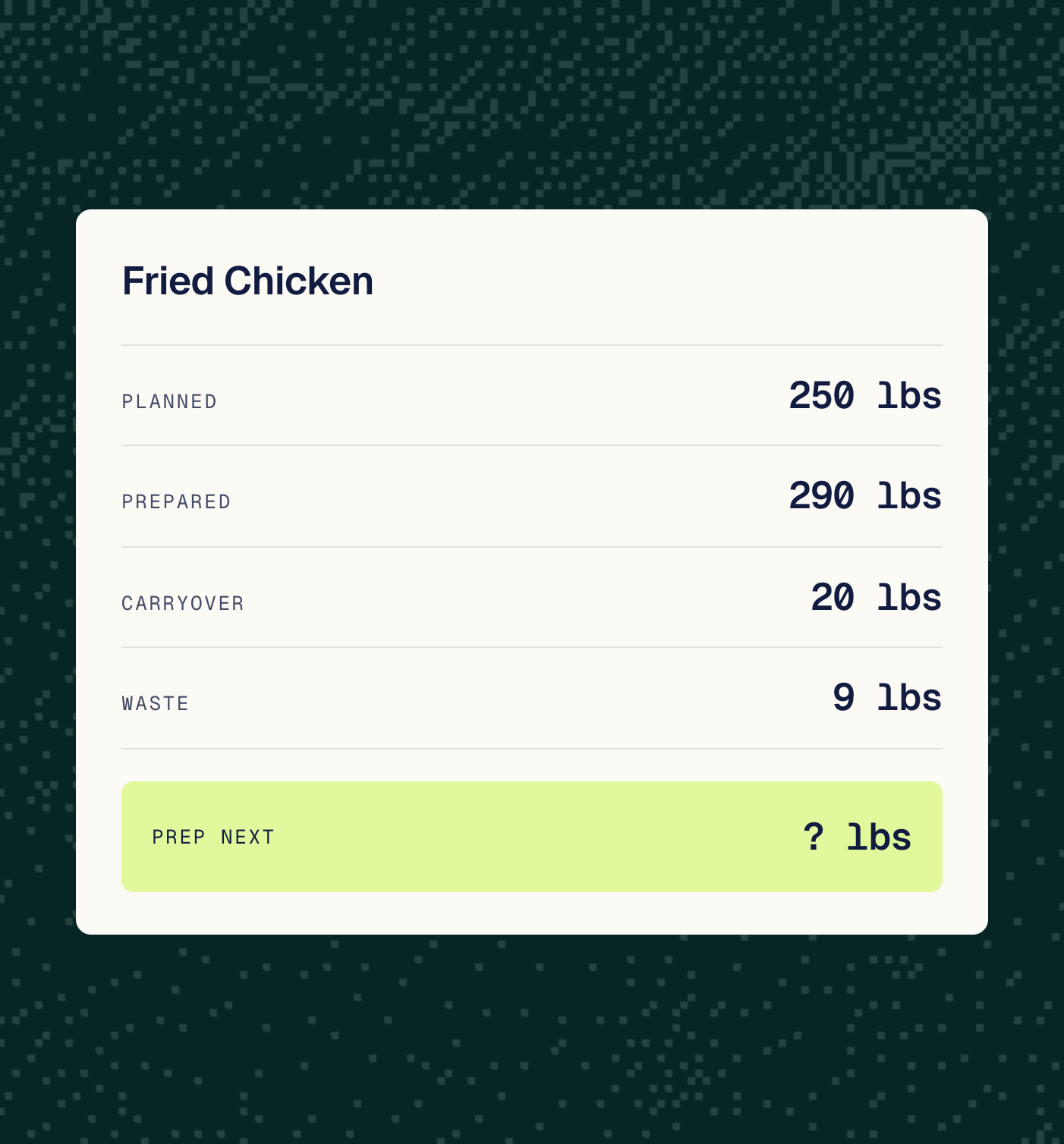
Picture someone sitting down with last cycle’s numbers and seeing that 40 pounds of fish were discarded one Tuesday. To make the right change to next cycle’s target, they may have to first determine which menu item it was—most tracking system don’t offer that precision—whether their team prepped to plan, how much was served (and ideally also consumed), and if it’s a trend or one-off issue. Repeating this across many items and many menus takes time that very few chefs have; it’s much more straightforward to skip the dot-connecting and base prep targets on gut instinct and guest counts.
Forecasting changes the outcome
Waste is prevented when upstream changes are made, not just when a report is read. Despite overproduction being both costly and theoretically solvable (with better demand planning), forecasting methods haven’t evolved much over the past few decades.
The same friction is present across the entire food and beverage industry. This 2024 study of F&B sales stated that “producing hourly demand forecasts is an important yet often tedious task for restaurant managers,” and it’s especially challenging for new managers who lack the experience (and instinct) to properly account for different holidays and weather conditions.
Luckily, the manual translation from a wasted pan to next week's forecast is exactly the number-crunching AI is best suited for. A different 2024 study found that, in a catering setting, utilizing specific machine-learning models to forecast demand led to a 14%-52% reduction in food waste versus traditional, manual methods. Within our own client base, leveraging AI to turn actuals into forecasts aligned with an average 11% plate-cost reduction across one foodservice provider's sites.
What StreamLine does differently
Like other systems, StreamLine gives teams trustworthy production (prep, carryover, waste) and plate waste data via smart scales and scanners. Unlike other systems, StreamLine then evaluates each item’s consumption trends, references your upcoming menus, and gives you an exact forecast for every dish.
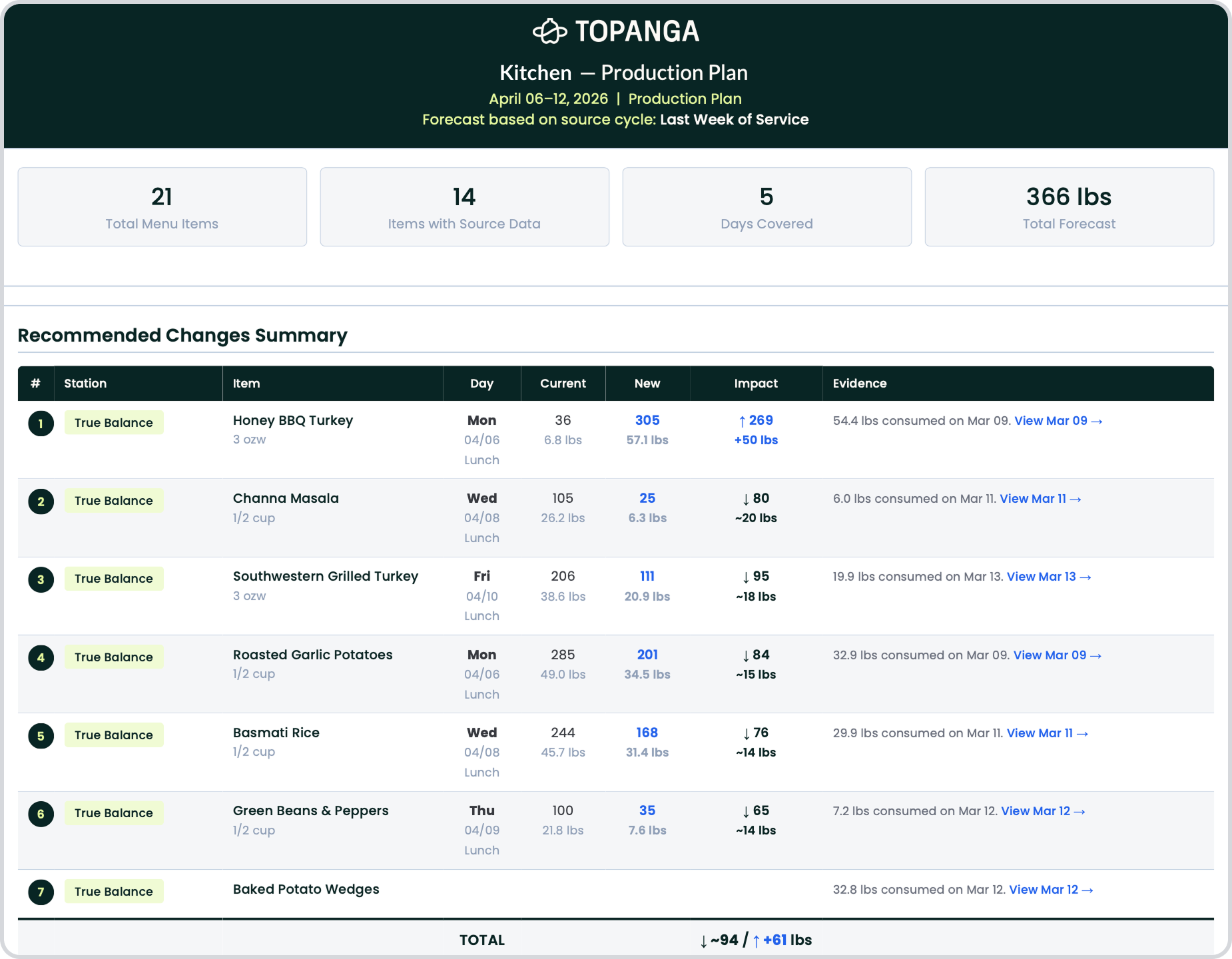
Here’s a real-world example: one of our clients regularly planned to serve 80+ lbs of Provencal Fish. But the dish wasn’t that popular, and the losses were hidden, so the plan (and end result) stayed the same. Then, they started using StreamLine. AI analyzed service data, found the gap, and generated a new forecast. The chef revised prep from 84 to 49 lbs, and 30+ lbs of costly waste—an estimated $240—were saved with one upstream decision.
In other kitchens, we see that teams are regularly prepping based on instinct, but not adjusting planned amounts back in the menu because of time required. Our full-funnel forecasts remove the need for admin updates that so easily fall by the wayside, keeping kitchens in sync.
Service style also matters; it’s great if your back-of-house team is prepping protein on par with acceptance at the line, but StreamLine's end-to-end visibility also captures the half-eaten chicken breasts coming back on diner’s plates. Teams are using this to inform service style and ensure credit for on-par production back-of-house isn’t sold-short by hidden waste streams.
If your forecasts are the same cycle-to-cycle, or your chefs have to jump between multiple tools to figure out how much fish to fire, your technology isn’t working hard enough for you. Here's what closing that loop actually looks like in a kitchen.
Continue reading


A Chef's POV: Managing With the Same Precision You Cook With
Chef Chris Aquilino draws on 35 years in kitchens to unpack how culinary leadership has changed. For the chefs who thrive today, systems are just as important as skills: getting data, improving demand forecasting, and sharing the knowledge across the team.

Why Tracking Waste is Just the Start, Not the Solution
Trustworthy production data is a kitchen's foundation. But it’s what happens next—how (or if) that data is used—that really makes the difference. Most tools in-market don’t make that easy enough for foodservice operators.