.svg)

2026 U.S. Food Waste Legislation Guide for Foodservice Leaders
US food waste laws are tightening fast, making accurate waste tracking essential. This 2026 guide covers food waste mandates across the US, including Connecticut, New Jersey, Massachusetts, California, Maryland, New York, and Washington State.

In the United States, between 30 and 40% of the food supply is wasted—approximately $161 billion worth. To put that into perspective, this amount of food could feed 150 million people. Because of this, the rules around food waste are changing fast. States across the US have recently passed legislation forcing major changes in how it is handled.
We'll break each relevant state's requirements down below, but here's a snapshot of what's happening:
The new standard—and a legal requirement, in more states every year—for foodservice operations is to track food waste, donate the surplus, and ultimately reduce what goes into landfills. Many foodservice teams, especially those in higher education, are rethinking their daily operating rhythm now that food waste is both a growing bottom-line threat and regulatory concern. Having a food waste program in place is becoming the only way to operate responsibly.
This guide digs into newer legislation and presents an easy-to-implement system for culinary teams who need reliable food waste data.
What are the Benefits of Reducing Food Waste?
You want to avoid fines for non-compliance. But the real upside of a food waste program goes beyond compliance. Well-run food waste programs have several benefits for your organization, including:
Cost savings
Wasting food is essentially throwing a portion of your budget away. Reducing food waste by even 20-25% by 2030 could save the world between $120-$300 billion per year. For higher education, healthcare, and hospitality foodservice programs, tackling the food waste problem would save would save hundreds of thousands of dollars a year.
Reducing environmental impacts
Right now, food waste is the single most common material landfilled and incinerated in the US—municipal solid waste landfills are the third-largest source of human-related methane emissions. Reducing what you toss in the trash is the fastest way to shrink the landfills that contribute to climate change.
Redirecting food to those in need
Every day, edible food is thrown away. Food waste programs catch the surplus before it ends up in the dumpster and get it to the wider community, turning a loss into a meal for some of the 18 million Americans experiencing food insecurity.
Which States Have Food Waste Legislation?
Several states across the US are introducing legal requirements around food waste management to reduce their environmental impact and help those experiencing food insecurity:
Connecticut
The law
Commercial Organics Recycling Law
Current status
Came into effect on January 1, 2025.
The scope
Businesses, organizations, higher education institutions and healthcare facilities that generate an average annual volume of 26 tons of food waste must separate and recycle it. Institutions must annually submit an electronic summary of the following:
- The amount of edible food donated
- The amount of food scraps recycled
- The organics recyclers and associated collectors used
The state government has made several recommendations to those affected by the law, advising them to:
- Reduce food waste through more efficient foodservice operations.
- Donate servable food to shelters, food rescue operations and food pantries.
Implications
If your kitchen makes more than 1,000lbs of food waste a week, you’re now legally forbidden to put that waste in the dumpster. You need to separate it and send it to a compost facility or donate it. To follow the law, your kitchen needs to prove you’re separating the food. If you can prove you’re generating less than 1,000lbs a week, there may be no need to pay for an expensive compost truck.
New Jersey
The laws
Bill NJ S3889 - Food Waste Reduction
Current status
The law came into effect on January 20, 2026.
The scope
Every New Jersey higher education institution must develop and implement a food waste reduction program on every campus to redirect unused excess food prepared or distributed at campus dining halls, facilities and events to local food programs, such as food pantries, soup kitchens, shelters and community non-profits.
Food waste reporting is also required—institutions must submit a report to the Governor and the Legislature on their contributions to local food security programs and publish the food waste report on their own websites.
Implications
Higher education culinary teams will need to prepare annual reports for the Governor. These reports will need to address exactly where your institution’s food waste went and show that you’re diverting what’s still edible to community organizations.
Massachusetts
The law
Commercial Food Material Disposal Ban
Current status
A lowered waste threshold came into effect on November 1, 2022.
The scope
Massachusetts has banned businesses and institutions that generate 0.5 tons or more of commercial organic waste (food and vegetable material) each week from disposing of it in dumpsters—an extension of the 2014 law that set a 1-ton threshold. The goal is to divert food waste from landfills to composting, conversion, recycling or reuse.
Implications
Since the 2014 waste ban originally came into effect with a one-ton limit, businesses and institutions across Massachusetts have dramatically changed how they dispose of waste. With the new threshold, many more businesses now need to keep a close watch on whether they’re over or under the 0.5 ton weekly threshold, which requires some form of routine food waste tracking. If waste is exceeding that weekly threshold, then tools like RecyclingWorks’ calculator is a useful resource for finding a local donation center. Even better is reducing that waste in the first place.
California
The law
SB 1383 Short-Lived Climate Pollution Reduction
Current status
The law came into effect on January 1, 2024.
The scope
The state law aims to protect the environment and support communities by achieving these statewide targets:
- Reducing disposal of organic waste by 50% by 2020, and by 75% by 2025
- Recovering at least 20% of disposed edible food for human consumption by 2025
All residents and businesses must separate organic materials—this includes food waste, yard waste and food-soiled paper into designated organic waste recycling containers. Plus, businesses are now required to donate as much edible food as possible, rather than throwing it out. The law separates businesses into two tiers:
- Tier 1: Businesses that generally have more produce, fresh groceries and shelf-stable foods to donate, such as wholesale food vendors, foodservice providers, grocery stores and supermarkets.
- Tier 2: Businesses that typically have more prepared foods to donate, including restaurants, hotels, cafeterias, health facilities, large venues and events.
The law also requires local governments and businesses to keep edible food recovery logs to prove their compliance.
Implications
Tier 2 generators, including universities and colleges and healthcare facilities, must change how they handle surplus food. To be sure they’re compliant with the law, many institutions are creating records of compliance to document exactly where surplus food is going, such as donations to food recovery organizations.
Maryland
The law
HB 264 Solid Waste Management - Organics Recycling and Waste Diversion - Food Residuals
Current status
The law came into effect on January 1, 2024.
The scope
Maryland’s solid waste management law is designed to reduce the amount of food waste sent to landfills and incinerators by requiring large food waste generators, including schools, supermarkets, businesses and institutional cafeterias, to divert organic waste to alternative, sustainable facilities if it exceeds 1 ton per week. It encourages these large food waste generators to:
- Reduce food waste in the first place through kitchen optimization
- Be accountable for food waste by recording the weight of food “residuals” (waste) weekly
- Donate safe-to-eat food to food rescue organizations
The law only applies to businesses and institutions within 30 miles of an organics recycling facility that are willing to accept food waste. Under this law, the threshold is calculated for each campus individually rather than for the entire university, college or school. It also requires these businesses and institutions to record the weight of food waste generated each week.
Implications
Since the one-ton rule came into effect, large food operators have had to choose between expensive hauling services and reducing the waste they generate. Reducing waste is a good start, but you need systems in place to show you where the waste is coming from and record what you did with it.
New York
The law
NY S5331 The Food Scraps and Food Donation Recovery Law
Current status
The law came into effect on January 1, 2026.
The scope
New York State has expanded the original Food Donation and Food Scraps Recovery Law, which mandated that businesses and institutions that generate an annual average of 2 tons or more per week must donate excess edible food and recycle remaining food scraps if they’re within 25 miles of an organics recycler. The amendments lower this threshold to an annual average of one ton per week.
Implications
This significant threshold reduction has meant that many New York businesses and institutions are now on the NYS Department of Environmental Conservation (DEC) audit list. To meet their audit requirements, you need hard numbers.
If you’re under the threshold, recording food waste provides you with the evidence you need to avoid potential fines for non-compliance. If you are over the threshold, your compliance records document the exact weight of food scraps diverted to organics recyclers and edible food donated to food recovery organizations.
Washington State
The law
HB 1799 Organics Management Law
Current status
The law came into effect on January 1, 2026.
The scope
Washington state just implemented one of the strictest organic food waste laws in the entire US in an effort to slash landfill methane emissions by 75% by 2030. Businesses and institutions that generate over 96 gallons of organic waste per week—roughly the volume of two standard rolling trash cans—must implement organic material management and document the process. Every single university and college dining hall in the state is now over this limit.
Implications
Institutions need an accurate way to record and prove that they are staying within their management plans. While tracking waste data is essential for demonstrating diversion rates to the Department of Ecology, knowing where to send excess edible food is just as important.
Tools like Washington’s Food Rescue Map provide a way for higher education institutions to act on their data. By identifying local food recovery organizations through the map, institutions can redirect edible items to the local community.
Reducing food waste at the federal level: The Zero Food Waste Act
It’s not just individual states signing food waste bills into law. The Zero Food Waste Act was reintroduced in Congress, signaling a shift in how the US handles waste on a national scale.
The law
Current status
The bill for the Zero Food Waste Act was reintroduced in Congress in early 2026, but hasn’t become law yet.
The scope
In December 2025, Senator Cory Booker introduced the Zero Food Waste Act, a federal bill that would provide EPA grants for food waste reduction projects, including measuring food waste and identifying strategies to reduce it. “The Zero Food Waste Act will create grants to make sure foods that otherwise would’ve needlessly gone to the landfill get eaten, upcycled into other products, or composted instead,” he said.
The EPA-administered program would provide $650 million in grants to state, local, tribal and territorial governments to bring food waste mitigation projects or policies to life in the most impactful way for communities. For example, measurement grants could be used to better understand the amount of food waste generated in a community.
Implications
If the Zero Food Waste Act becomes law, it presents a big opportunity for universities and colleges that are already implementing food waste reduction programs. If they can prove they have a successful food waste reduction program in place, institutions may be able to access food waste grants to help cover the cost.
However, federal grants typically require reliable data. If your institution can prove that it is implementing food waste reduction measures with hard data, you’re essentially providing them with proof that it's worth funding.
We recommend keeping a close eye on the bill's cosponsors. When a Senator from your state signs on, it’s a signal that federal funding for food waste is becoming a local priority. If you see your local representatives joining the bill, it might be time to get a pilot program running to ensure you’re first in line for the funding.
How StreamLine Helps You Track and Reduce Food Waste
To start reducing food waste or find out which level of state requirements you’re subject to, you need to understand how much food you’re wasting to begin with. That’s where StreamLine comes in.
StreamLine is a production tracking and optimization platform that helps you gain better data across every stage of production for accurate menu planning and less waste.
Until now, understanding exactly what’s happening on the line meant wrangling with physical worksheets or enforcing limited, time-consuming digital tracking tools. But we believe that optimized production starts with fast and fluid data capture. The StreamLine smart scale’s one-tap interface and AI item recognition capabilities unlock frictionless food waste management, giving you a full picture of production without the admin.
.jpg)
How it works
StreamLine records what’s actually happening on the line—for confident decisions that prevent waste. Here’s a step-by-step of the process:
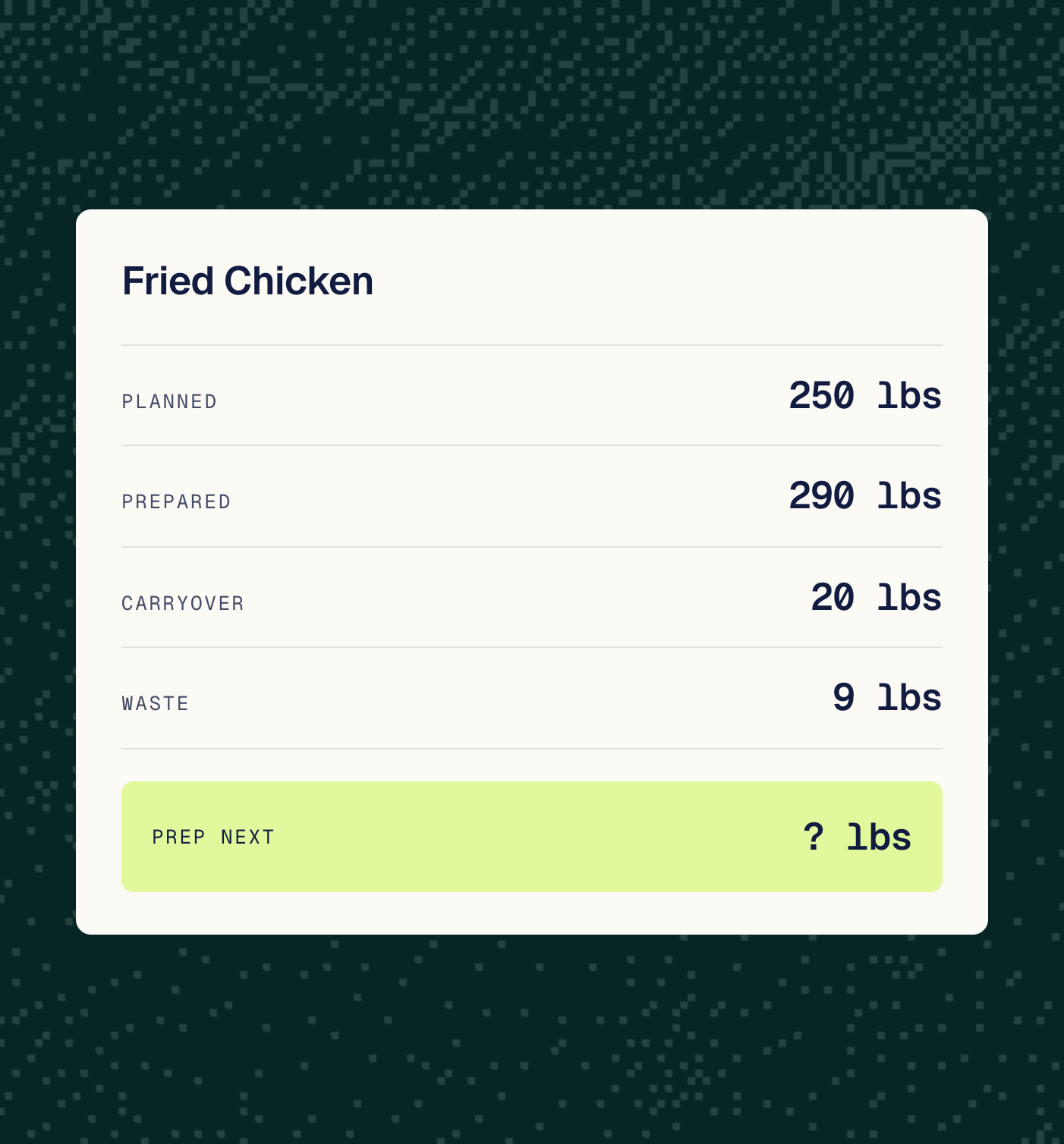
- Capture: A cook places a tray of food—prepared, carryover, or waste (trimmings, spoilage, overproduction)—on the smart scale, and records item weight in one tap while a connected camera snaps a photo. Recorded waste can be tagged as a donation.
- Analyze: The cook's job is done. StreamLine's powerful AI models match data to the correct menu item and its cost.
- Act: Real-time production data flows into the StreamLine dashboard and is automatically sent back to your menu system for easier planning. Chefs clearly see their biggest budget drains and stay current on waste-reduction progress with regular reports.
Boost your bottom line
Every tray of food you throw away is lost profit. By identifying exactly where overproduction is coming from, StreamLine helps you reduce purchasing costs. For example, using StreamLine, Ohio State University saved $95,000 on food costs in just over a year. Interested in how much your kitchen could save with StreamLine? Use our ROI calculator to find out.
Ensure compliance with accurate food waste tracking
Many states require businesses and institutions to maintain records of organic waste. StreamLine provides access to the reliable data you need to satisfy state waste reporting requirements without resorting to time–consuming manual logs.
Avoid non-compliance fines
As states increase enforcement, best guesses aren’t going to help you avoid penalties. Think of StreamLine as your digital audit trail, providing the proof you need to demonstrate you’re diverting food waste correctly.
Help your community
Reducing waste isn’t just about reducing what’s going in the bin—it’s also about what goes on the table. Teams using StreamLine can mark food waste recordings as donations and get tangible data to back up their work with local food recovery organizations.
See How Leading Kitchens Eliminate Waste
From kitchen overproduction to single-use packaging, Topanga powers 500+ kitchens with the tools to cut waste, lower costs and hit your sustainability goals.
Want to see StreamLine in action? Book a demo to see how we help foodservice organizations across the education, healthcare, and hospitality sectors stay compliant while cutting costs.
Continue reading

A Chef's POV: Managing With the Same Precision You Cook With
Chef Chris Aquilino draws on 35 years in kitchens to unpack how culinary leadership has changed. For the chefs who thrive today, systems are just as important as skills: getting data, improving demand forecasting, and sharing the knowledge across the team.

Why Tracking Waste is Just the Start, Not the Solution
Trustworthy production data is a kitchen's foundation. But it’s what happens next—how (or if) that data is used—that really makes the difference. Most tools in-market don’t make that easy enough for foodservice operators.